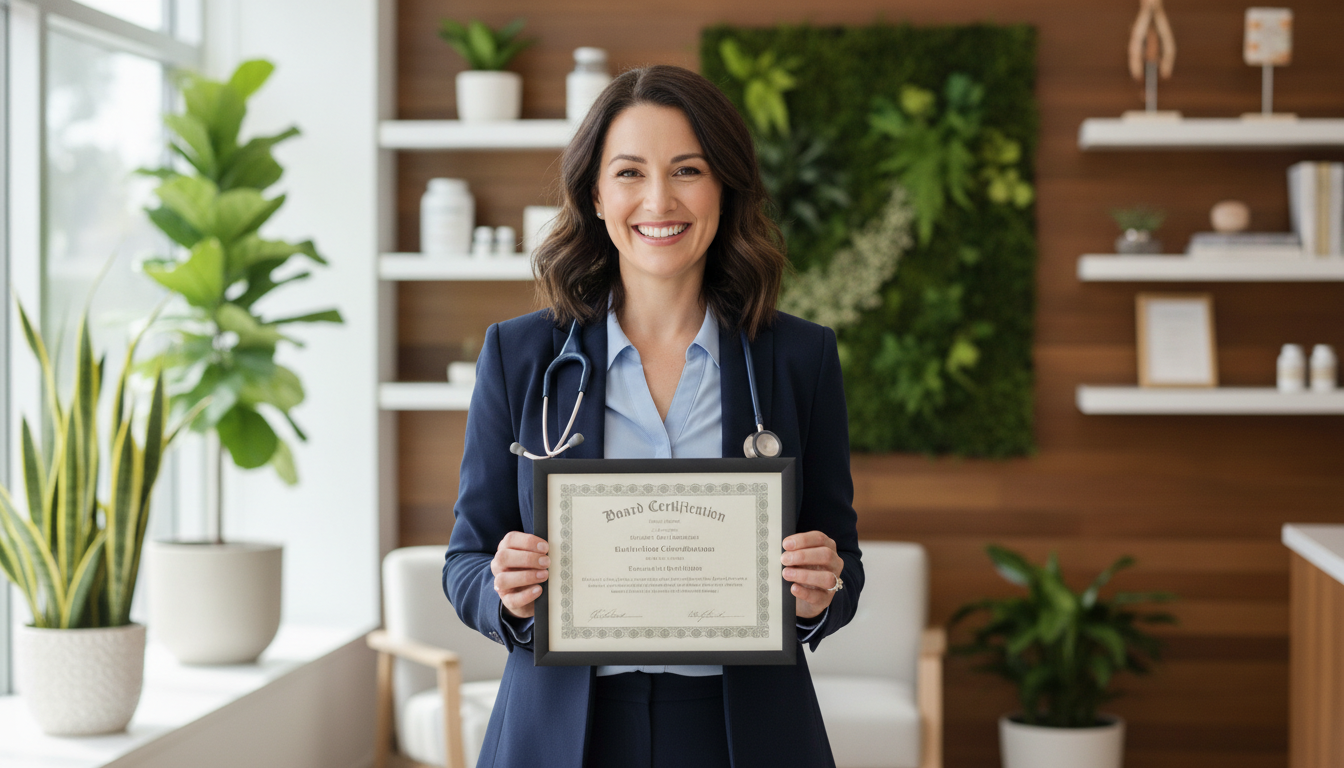
If you are a nurse pursuing functional medicine education, you may be wondering: Does becoming board certified in functional medicine really matter?
This title may appeal to nurses who want their credential to reflect their faith and who incorporate Christian perspectives into wellness education when clients welcome them.
You may also have noticed that there are multiple functional medicine board certification titles and multiple organizations offering credentials.
So which certification is legitimate? Is there an official functional medicine board? And which credential should a nurse choose?
These are important questions, and understanding how professional certification works can help you make an informed decision about which credentials you want to pursue after completing your functional medicine education.
Why Functional Medicine Board Certification Can Be Valuable for Nurses
Board certification provides an additional layer of professional credibility.
Your nursing license already demonstrates that you have completed the education and regulatory requirements necessary to practice within your nursing role. When you pursue additional education in a specialty such as functional medicine, a professional board certification can provide another way to demonstrate your additional training and expertise in that area.
This can be valuable whether you want to work for an established functional medicine practice or establish your own functional nursing business business.
For example, imagine that a functional medicine practice is considering several nurses for a position. Nursing experience, personality, clinical background, education, and other factors will certainly matter. However, completing comprehensive functional medicine education and obtaining an additional professional credential in that specialty may help demonstrate that you have intentionally invested in developing your knowledge in functional medicine.
The same principle applies to independent practice.
Potential clients may consider your nursing background, education, experience, reputation, professionalism, and specialized training when deciding whom they want to work with. Board certification provides one additional layer of professional credibility.
Board Certification Also Provides Third-Party Recognition
There is another benefit that I believe is particularly important: third-party recognition of your education.
A school can create a program and tell prospective students that its education is comprehensive. However, when independent professional organizations review an educational program and determine that its graduates meet educational requirements for their credentials, there is an additional layer of outside review.
This is one reason Functional Nurse Academy has intentionally pursued relationships with multiple professional organizations.
Functional Nurse Academy:
Provides 90 nursing contact hours
Is an approved provider of continuing nursing education
Has been peer-reviewed and endorsed by the American Holistic Nurses Association (AHNA)
Is an Interprofessional Partner of the Institute for Functional Medicine (IFM)
Is accredited through both the American Association of Natural Wellness Practitioners (AANWP) and the American Association of Natural Wellness Coaches (AANWC)
for multiple board certification pathways
CEs earned from the Functional Nurse Academy meet the CE requirements for board certifications offered through The American Holistic Nurses Credentialing Corporation (AHNCC).
for multiple board certification pathways
CEs earned from the Functional Nurse Academy meet the CE requirements for board certifications offered through The American Holistic Nurses Credentialing Corporation (AHNCC).
These organizations serve different purposes, and these relationships are not all the same type of approval, endorsement, or partnership. However, together they demonstrate FNA's commitment to seeking independent professional review and providing nurses with education that can be applied toward multiple professional credentials.
Is There an Official Functional Medicine Board Certification?
This is where some of the confusion surrounding functional medicine certification begins.
There is currently no single government-designated governing body that issues the one official functional medicine board certification for healthcare professionals in the United States.
Instead, there are multiple independent, nongovernmental professional organizations that offer certifications related to functional medicine, functional wellness, holistic health, health coaching, and related specialties.
These private organizations establish their own educational standards, eligibility requirements, examinations when applicable, continuing education requirements, and professional credentialing standards.
Some organizations also review educational programs to determine whether graduates of those programs meet the educational requirements to apply for their professional certifications.
This is why you may see healthcare professionals with different functional medicine credentials after their names.
What Is a Private Board Certification?
A professional board certification is different from a professional license.
Your nursing license is issued through a governmental regulatory structure and establishes your legal authority to practice nursing within the applicable jurisdiction and scope.
A private professional certification is issued by a nongovernmental credentialing organization to recognize that an individual has met that organization's established requirements in a particular area of education or professional competency.
That distinction is extremely important.
Board certification does not expand your legal scope of practice.
Your underlying professional license and applicable state laws continue to determine what you may legally do.
Board certification is an additional professional credential recognizing education or competency in a specialty—not a new healthcare license.
Why Does Functional Nurse Academy Have Multiple Board Certification Pathways?
Once you understand that there is no single government body issuing one universal functional medicine certification, it becomes much easier to understand why FNA graduates have multiple certification opportunities.
Different independent credentialing organizations recognize different areas of professional education and offer different professional titles.
Rather than limiting FNA graduates to one credential, Functional Nurse Academy has pursued eligibility pathways that allow nurses to select certifications that best align with their professional goals.
Eligible FNA graduates have multiple certification pathways through AANWP, AANWC, and AHNCC, depending upon the particular credential and its complete eligibility requirements.
Some nurses want a title that emphasizes functional medicine.
Others want a credential that specifically combines nursing and functional medicine.
Some want to emphasize functional health coaching.
Others may want to pursue a nationally accredited holistic nursing or nurse coaching certification.
There isn't necessarily one certification that is right for every nurse.
The better question is:
Which credential most accurately represents my education, nursing license, professional role, and the services I provide?
Which Board Certification Should an FNA Graduate Choose?
Board Certified Functional Medicine Practitioner | BC-FMP
The BC-FMP is one of the most commonly selected credentials among Functional Nurse Academy graduates.
Many nurses choose this credential because they want their professional title to clearly communicate their additional education in functional medicine.
However, there is an important consideration for RNs and LPN/LVNs.
A client who sees RN or LPN alongside a credential containing the word practitioner could potentially misunderstand the nurse's professional role.
If you are an RN or LPN/LVN who chooses a certification containing the word practitioner, be particularly cognizant of this potential for confusion.
Clearly identify:
Your actual nursing license and credentials
The complete board certification title
The private organization that issued the certification
Your professional role and scope of services
Any appropriate scope-of-practice disclosures
For example, an RN holding BC-FMP might clearly state that they are a Registered Nurse and Board Certified Functional Medicine Practitioner through AANWP while also making it clear that they are not a nurse practitioner and do not independently diagnose, treat, prescribe, or manage medical conditions.
The goal is transparency.
Board Certified Functional Medicine Nurse Specialist | BC-FMNS
The BC-FMNS specifically emphasizes both the individual's nursing background and additional education in functional medicine.
This may be an attractive credential for nurses who want their professional title to communicate that they have specialized functional medicine education within their nursing background.
However, the word “specialist” also deserves consideration.
For an RN or LPN/LVN, terms such as practitioner and specialist could potentially be interpreted by some members of the public as indicating an advanced practice role or expanded clinical authority.
The credential itself does not provide that authority.
Therefore, nurses selecting BC-FMNS should clearly identify their nursing license, the organization issuing the certification, and their actual scope of practice.
I also recommend that nurses review their Nurse Practice Act and, when appropriate, seek guidance from their Board of Nursing or qualified healthcare legal counsel regarding the use of professional titles.
Board Certified Functional Wellness Professional | BC-FWP
The BC-FWP provides a broader wellness-focused credential.
This may appeal to nurses who want their certification to emphasize functional wellness without using either nurse or practitioner within the certification title.
Board Certified Functional Nurse Health Coach | BC-FNHC
The BC-FNHC combines nursing, functional health, and coaching within one professional credential.
This can be an excellent option for nurses whose services emphasize education, lifestyle modification, behavior change, accountability, goal setting, and wellness coaching.
Board Certified Functional Health Coach | BC-FHC
The BC-FHC provides a functional health coaching credential without using the word nurse.
This may be attractive to professionals who want a general health coaching credential or nurses who maintain a distinct health coaching role.
As with every credential discussed in this article, certification does not independently determine your legal scope of practice.
Board Certified Christian Wellness Practitioner | BC-CWP
Board Certified Christian Wellness Practitioner | BC-CWP
The BC-CWP is an option for Functional Nurse Academy graduates who have completed our elective Christian content.
This title may appeal to nurses who want their credential to reflect their faith and who incorporate Christian perspectives into wellness education when clients welcome them.
Holistic Nurse Board Certification
Functional Nurse Academy has also been peer-reviewed and endorsed by the American Holistic Nurses Association (AHNA).
Because of this pathway, nursing contact hours earned through FNA can be applied toward the continuing education requirements for applicable certifications through the American Holistic Nurses Credentialing Corporation (AHNCC), subject to AHNCC's complete eligibility requirements.
AHNCC offers nationally accredited holistic nursing certifications, including:
HN-BC® — Holistic Nurse Board Certified
HNB-BC® — Holistic Nurse Baccalaureate Board Certified
AHN-BC® — Advanced Holistic Nurse Board Certified
APHN-BC® — Advanced Practice Holistic Nurse Board Certified
The appropriate certification depends upon the nurse's education, license, professional experience, and other eligibility requirements.
This pathway is different from the private functional medicine certifications discussed above. AHNCC's holistic nursing certification programs are nationally accredited nursing specialty certifications.
For nurses who want a credential specifically recognizing their expertise within the nursing specialty of holistic nursing, this can be an excellent pathway to explore.
Nurse Coach Board Certification | NC-BC®
Another option available to nurses is the Nurse Coach Board Certified (NC-BC®) credential through AHNCC.
The nursing contact hours earned through Functional Nurse Academy can be applied toward the continuing nursing education requirements for this credential, subject to AHNCC's complete eligibility requirements.
However, there is an important distinction for students to understand.
Completing FNA alone does not fulfill all of the requirements for initial NC-BC® certification.
AHNCC has additional eligibility requirements, including nursing education and experience requirements, qualifying continuing nursing education, and supervised or mentored coaching experience.
Functional Nurse Academy does not currently provide the required supervised coaching hours.
Therefore, an FNA graduate interested in pursuing NC-BC® would need to independently satisfy AHNCC's remaining requirements.
For nurses who want their professional identity to strongly emphasize nurse coaching, however, NC-BC® provides another valuable certification pathway.
A Simple Way to Choose Your Certification
Think first about what you want your credential to communicate.
Functional medicine is the primary identity you want to communicate:
Consider BC-FMP (Board Certified Functional Medicine Practitioner)
Nursing + functional medicine:
Consider BC-FMNS (Board Certified Functional Medicine Nurse Specialist)
Functional wellness:
Consider BC-FWP (Board Certified Functional Wellness Professional)
Nursing + functional health coaching:
Consider BC-FNHC (Board Certified Functional Nurse Health Coach)
General functional health coaching:
Consider BC-FHC (Board Certified Functional Health Coach)
You’ve completed FNA’s elective Christian content and want to highlight how you incorporate Christian principles into your wellness practice:
You’ve completed FNA’s elective Christian content and want to highlight how you incorporate Christian principles into your wellness practice:
Consider BC-CWP (Board Certified Christian Wellness Practitioner)
Nationally accredited holistic nursing specialty certification:
Consider HN-BC (Holistic Nurse Board Certified)
Nationally accredited nurse coaching certification:
Explore NC-BC (Nurse Coach Board Certified), understanding that additional eligibility and supervised coaching requirements apply.
Some nurses may ultimately decide to obtain more than one credential because different certifications communicate different aspects of their professional education.
The right board certification should reflect your education and the work you do. A board certification credential can strengthen your credibility in the specialty by showing that you have pursued specialized education and met the requirements of an independent credentialing organization. Choose a title that clearly communicates your expertise, and use it in a way that helps clients understand your qualifications and the services you provide.
Frequently Asked Questions About Becoming a Functional Nurse
What is a functional nurse?
A functional nurse is a licensed nurse who applies the principles of functional medicine to educate and empower clients by helping them identify and address potential root causes of health concerns. Functional nurses focus on nutrition, lifestyle, sleep, stress management, environmental influences, and other evidence-informed approaches while practicing within their nursing scope of practice.
What is the difference between a functional practice owned by a NP and RN or LPN?
Nurse practitioners may operate a medical practice where permitted by state law. Depending on their state's regulations, NPs may diagnose medical conditions, order and interpret laboratory testing, prescribe medications, and provide medical treatment.
RNs and LPNs can own and operate independent wellness-focused functional nursing practices. Rather than diagnosing or treating medical conditions, they educate and empower clients through personalized wellness plans, nutrition and lifestyle education, health coaching, specialty laboratory education and on going support.
How Do Non-Advanced Practice Functional Nurses Utilize Laboratory Testing?
RNs and LPNs can access both conventional and specialty laboratory testing through partnerships with functional medicine laboratories. These partnerships allow nurses to order testing through a physician network at affordable wholesale pricing, while practicing within their professional scope.
While nurse practitioners (NPs) may have the authority to diagnose medical conditions and independently order laboratory testing depending on their state laws, non-advanced practice nurses use laboratory data to educate clients about potential patterns of dysfunction. Laboratory findings can also help guide personalized wellness recommendations and support collaboration with the client's healthcare team to optimize health outcomes.
Please note: Certain states, including New Jersey (NJ) and Rhode Island (RI), have restrictions on laboratory ordering through some functional medicine laboratory networks.
Does Functional Nurse Academy provide continuing education for nurses?
Functional Nurse Academy is an approved provider of continuing nursing education. Graduates receive 90 nursing contact hours, approved for LPNs, RNs, and NPs.
The program combines comprehensive functional medicine education with practical application, case studies, and business mentorship, giving nurses the knowledge, tools, and confidence to launch and grow their own functional wellness businesses.
Can I become board certified after completing Functional Nurse Academy?
Yes! Functional Nurse Academy graduates are eligible for the following practitioner level board certifications through American Association of Natural Wellness Practitioners (AANWP)
- Functional Medicine Nurse Specialist | BC-FMNS
- Functional Medicine Practitioner | BC-FMP
- Functional Wellness Professional | BC-FWP
- Christian Wellness Practitioner | BC-CWP (for students completing our optional Christian content)
Below are the coaching credentials that our graduates qualify for through the American Association of Natural Wellness Coaches (AANWC)
- Functional Nurse Health Coach | BC-FNHC
- Functional Health Coach | BC-FHC
This program has been peer-reviewed and is endorsed by The American Holistic Nurses Association
CEs earned from the Functional Nurse Academy meet CE eligibility requirements for the following American Holistic Nurses Association board certification titles:
- HN-BC® (Holistic Nurse Board Certified)
- HNB-BC® (Holistic Nurse Baccalaureate Board Certified)
- AHN-BC® (Advanced Holistic Nurse Board Certified)
- APHN-BC® (Advanced Practice Holistic Nurse Board Certified)
- NC-BC® (Nurse Coach Board Certified)
What is included in enrollment?
Functional Nurse Academy is the leading and most comprehensive functional nursing program on the market for LPN, RN and NP. Enrollment includes the following:
- 90 Nursing Contact Hours of functional nursing education
- Multiple Board Certification Pathways in functional medicine and holistic nursing
- Functional Nurse Toolkit with business resources and practice-building tools
- Social Media & Marketing Kit with 9 months of content, brochures, and business card templates
- 40+ Advanced Trainings covering functional medicine and business strategy (available in FNA monthly mentorship library)
- Six Months of FNA’s Monthly Mentorship Program FREE, including live educational trainings and 60 minutes of live Q&A each month, all hosted by FNA Founder Melissa Schreibfeder, BSN, RN, BC-FMP, plus case studies and full access to the mentorship library.
Functional Nurse Academy is the nation’s leading and most comprehensive functional nursing education program for LPNs, RNs, and NPs
Founded in 2022 by Melissa Schreibfeder, BSN, RN, BC-FMP.
We are Dual Accredited, Peer Reviewed and Endorsed
American Holistic Nurses Association Endorsed and Peer Reviewed
Institute for Functional Medicine Interprofessional Partner
Approved Provider of Continuing Nursing Education. Approved for 90 Nursing CEs
Accredited for multiple board certification titles through AANWP, AANWC & AHNCC
Write your awesome label here.
Ready to take the next step?
I’m so happy you’re interested in functional nursing! I’d love to connect with you at my next live informational + Q&A webinar, where you’ll learn all about functional nursing, how nurses across the country are launching their own functional wellness businesses, and how you can get started.
You’ll also have the opportunity to meet me live and get all of your questions answered!
Just click below to save your seat! I hope to see you there!
-Melissa Schreibfeder, BSN, RN, BC-FMP Founder & CEO, Functional Nurse Academy
You’ll also have the opportunity to meet me live and get all of your questions answered!
Just click below to save your seat! I hope to see you there!
-Melissa Schreibfeder, BSN, RN, BC-FMP Founder & CEO, Functional Nurse Academy
Contact us
Thank you!
Functional Nurse Academy is the nation’s leading and most comprehensive functional nursing program for LPNs, RNs, and nurse practitioners. Founded in 2022 by Melissa Schreibfeder, BSN, RN, BC-FMP.