🎧 Listen to my podcast with Koral below!

When Koral Worsham, RN, BC-FMP first entered nursing nearly two decades ago, she was driven by a desire to help people heal. Over the course of her 19-year nursing career, she gained experience in Pediatrics, General Medicine, Oncology, the NICU, Emergency Medicine, Outpatient Clinics, and Telephone Triage. Yet despite her extensive clinical experience, she often felt frustrated by a healthcare system focused primarily on symptom management rather than uncovering the underlying causes of illness.
That frustration became deeply personal when her mother was diagnosed with Parkinson's disease.
As Koral searched for answers beyond conventional treatment options, she discovered functional medicine and began learning about the profound impact that nutrition, gut health, environmental exposures, lifestyle factors, and toxic burden can have on chronic disease. Determined to expand her knowledge and serve patients differently, she enrolled in the Functional Nurse Academy.
What Koral loved about Functional Nurse Academy
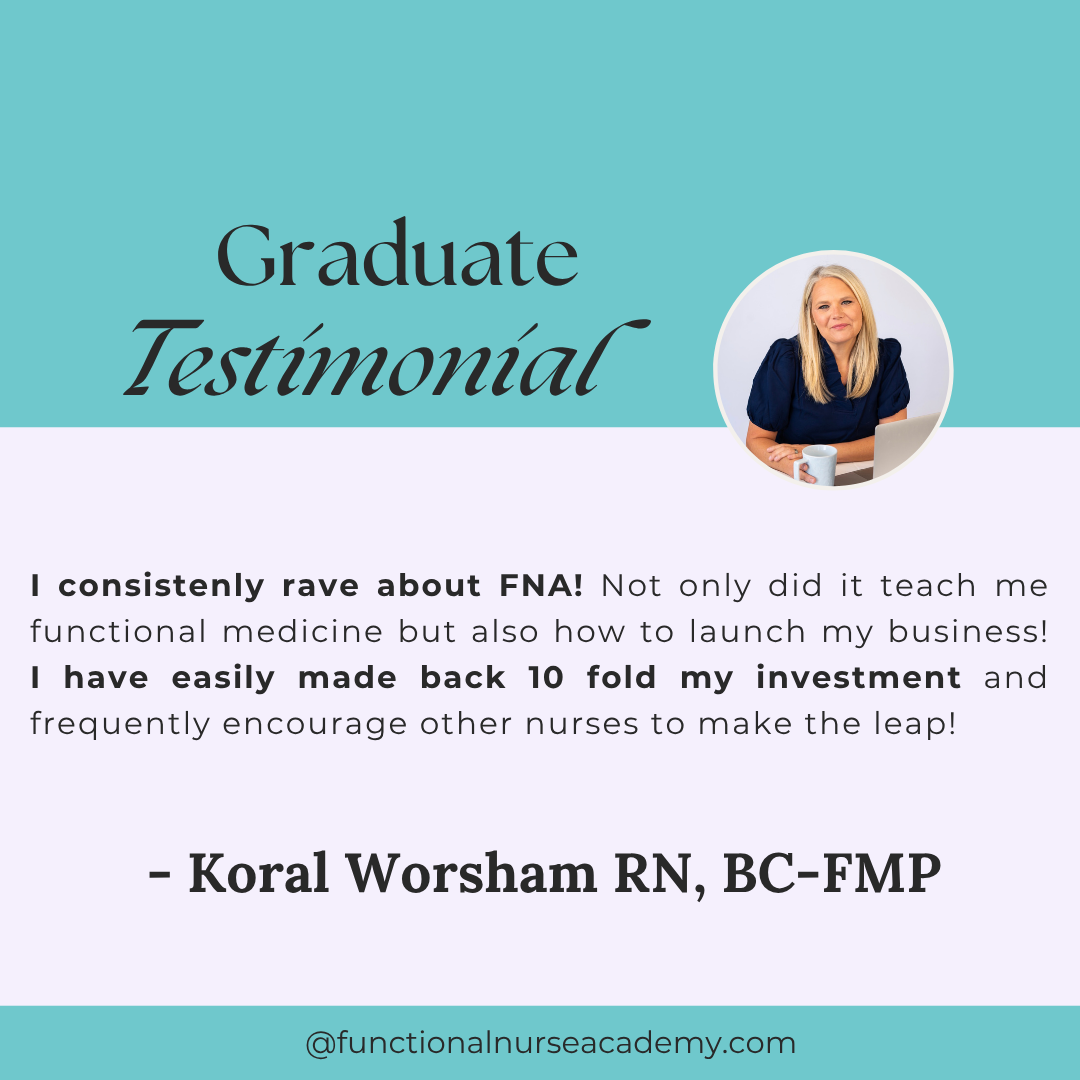
"Whenever I talk about the Functional Nurse Academy, I rave about it because it gave me all of the foundational knowledge in functional medicine that I needed—and even taught me how to start a business. I always encourage other nurses to take the leap of faith and enroll. Honestly, it was absolutely worth the investment, and I have made back my investment at least tenfold."
Prefer to watch? Watch my interview with Koral below!
Koral's Client Case Study:
Uncovering Mold-Related Neuroinflammatory Illness
About Koral Worsham, RN
Frequently Asked Questions About Becoming a Functional Nurse
What is a functional nurse?
A functional nurse is a licensed nurse who applies the principles of functional medicine to educate and empower clients by helping them identify and address potential root causes of health concerns. Functional nurses focus on nutrition, lifestyle, sleep, stress management, environmental influences, and other evidence-informed approaches while practicing within their nursing scope of practice.
What is the difference between a functional practice owned by a NP and RN or LPN?
Nurse practitioners may operate a medical practice where permitted by state law. Depending on their state's regulations, NPs may diagnose medical conditions, order and interpret laboratory testing, prescribe medications, and provide medical treatment.
RNs and LPNs can own and operate independent wellness-focused functional nursing practices. Rather than diagnosing or treating medical conditions, they educate and empower clients through personalized wellness plans, nutrition and lifestyle education, health coaching, specialty laboratory education and on going support.
How Do Non-Advanced Practice Functional Nurses Utilize Laboratory Testing?
RNs and LPNs can access both conventional and specialty laboratory testing through partnerships with functional medicine laboratories. These partnerships allow nurses to order testing through a physician network at affordable wholesale pricing, while practicing within their professional scope.
While nurse practitioners (NPs) may have the authority to diagnose medical conditions and independently order laboratory testing depending on their state laws, non-advanced practice nurses use laboratory data to educate clients about potential patterns of dysfunction. Laboratory findings can also help guide personalized wellness recommendations and support collaboration with the client's healthcare team to optimize health outcomes.
Please note: Certain states, including New Jersey (NJ) and Rhode Island (RI), have restrictions on laboratory ordering through some functional medicine laboratory networks.
Does Functional Nurse Academy provide continuing education for nurses?
Functional Nurse Academy is an approved provider of continuing nursing education. Graduates receive 90 nursing contact hours, approved for LPNs, RNs, and NPs.
The program combines comprehensive functional medicine education with practical application, case studies, and business mentorship, giving nurses the knowledge, tools, and confidence to launch and grow their own functional wellness businesses.
Can I become board certified after completing Functional Nurse Academy?
Yes! Functional Nurse Academy graduates are eligible for the following practitioner level board certifications through American Association of Natural Wellness Practitioners (AANWP)
- Functional Medicine Nurse Specialist | BC-FMNS
- Functional Medicine Practitioner | BC-FMP
- Functional Wellness Professional | BC-FWP
- Christian Wellness Practitioner | BC-CWP (for students completing our optional Christian content)
Below are the coaching credentials that our graduates qualify for through the American Association of Natural Wellness Coaches (AANWC)
- Functional Nurse Health Coach | BC-FNHC
- Functional Health Coach | BC-FHC
This program has been peer-reviewed and is endorsed by The American Holistic Nurses Association
CEs earned from the Functional Nurse Academy meet CE eligibility requirements for the following American Holistic Nurses Association board certification titles:
- HN-BC® (Holistic Nurse Board Certified)
- HNB-BC® (Holistic Nurse Baccalaureate Board Certified)
- AHN-BC® (Advanced Holistic Nurse Board Certified)
- APHN-BC® (Advanced Practice Holistic Nurse Board Certified)
- NC-BC® (Nurse Coach Board Certified)
What is included in enrollment?
Functional Nurse Academy is the leading and most comprehensive functional nursing program on the market for LPN, RN and NP. Enrollment includes the following:
- 90 Nursing Contact Hours of functional nursing education
- Multiple Board Certification Pathways in functional medicine and holistic nursing
- Functional Nurse Toolkit with business resources and practice-building tools
- Social Media & Marketing Kit with 9 months of content, brochures, and business card templates
- 40+ Advanced Trainings covering functional medicine and business strategy (available in FNA monthly mentorship library)
- Six Months of FNA’s Monthly Mentorship Program FREE, including live educational trainings and 60 minutes of live Q&A each month, all hosted by FNA Founder Melissa Schreibfeder, BSN, RN, BC-FMP, plus case studies and full access to the mentorship library.
Write your awesome label here.
Ready to take the next step?
I’m so happy you’re interested in functional nursing! I’d love to connect with you at my next live informational + Q&A webinar, where you’ll learn all about functional nursing, how nurses across the country are launching their own functional wellness businesses, and how you can get started.
You’ll also have the opportunity to meet me live and get all of your questions answered!
Just click below to save your seat! I hope to see you there!
-Melissa Schreibfeder, BSN, RN, BC-FMP Founder & CEO, Functional Nurse Academy
You’ll also have the opportunity to meet me live and get all of your questions answered!
Just click below to save your seat! I hope to see you there!
-Melissa Schreibfeder, BSN, RN, BC-FMP Founder & CEO, Functional Nurse Academy
Functional Nurse Academy is the nation’s leading and most comprehensive functional nursing program for LPNs, RNs, and nurse practitioners. Founded in 2022 by Melissa Schreibfeder, BSN, RN, BC-FMP.